

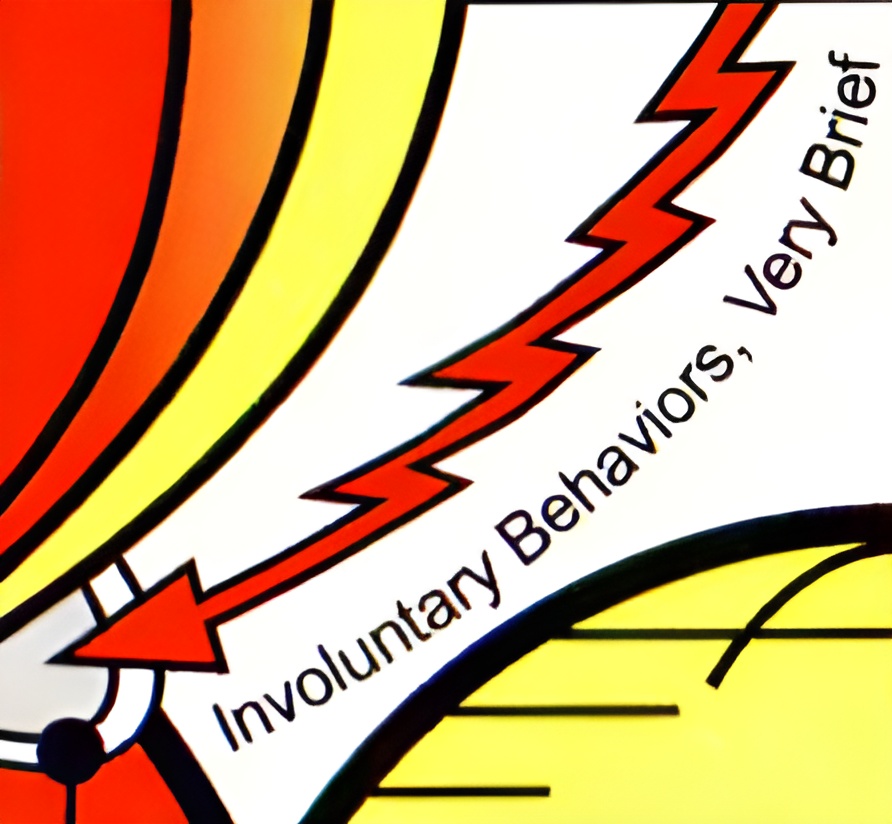
The Choice Theory Brain Chart and the “Involuntary Behaviour, Very Brief” signal.
Choice Theory as a personal growth tool is exceptional. I know this from personal experience and teaching it into my fourth decade to individuals and groups. One concept from Bill Glasser’s Choice Theory Chart – I will call it the Brain Chart – that stands out for me in teaching is the lightning bolt that comes from the Comparing Place (scales) and zaps the Perceived World. On the brain chart it is called “Involuntary Behaviour, Very Brief.”
We know there are two sides to the brain chart, what we call Situation A (red) which stands for “Not Now in Effective Control,” and Situation B (yellow) which stands for “Gaining more Effective Control.” It is very rare that any behaviour according to Glasser is pure pain (red) or pure pleasure (yellow), hence the two sides to the Brain Chart demonstrate that any chosen behaviour is usually a mix of both pleasure and pain. You open a present, and in that instant, you perceive what it is you get as a very brief pure pleasure signal (yellow) that then morphs into a longer lasting Total Behaviour of pleasure. (big smile, clap hands, hold present up to show everyone.) Everything is right about the present except the colour, it is not your favourite colour so there is a painful perception that is then swamped by the pleasure of the gift. On another occasion, you open a present, and it is all wrong for you – too small, wrong design, wrong colour in fact everything is wrong about it! Instantly on opening the present your perception is pure pain – (red), and it is followed by a longer lasting painful Total Behaviour of disappointment. (deep sigh, shaking of the head, put the present to one side.) But there is a pleasurable perception, the thinking that it was very kind of your friend to think of giving you a present at all.
That pure pleasure or pure pain signal in your brains is very brief – let’s say a nanosecond in terms of time span. On the Brain Chart it is designated as the ‘little lighting bolt’ that emanates from the Comparing Place (Scales) and flows into the Perceived World. Its purpose is to alert our brains that the perception of the present is more pleasurable or more painful. In that nanosecond you compare (scales) what you perceived from the Real World (world outside your head) to what you want in your Quality World (world inside your head.) and depending on the pain or pleasure of the perception signal, you then engage in Total Behaviour.
It is a very brief signal, and it is also an involuntary behaviour, meaning you have no control over this nano second in time when it happens. Glasser said he thought this very brief behaviour was the one time in understanding Choice Theory that you have no control over your behaviour. You are quietly reading and suddenly a door slams shut, and you just about jump out of your skin. Your perception is shaped first by the very brief perception of the noise (painful – that nano second in time) and is followed immediately by a total Behaviour (jumping up out of your seat, perceive the event, laugh at yourself and sit back down.)
So why is this Involuntary Behaviour, Very Brief signal important in Choice Theory? Here are some thoughts:
- That nanosecond in time or the ‘ahha’ moment in Choice Theory terms when it occurs, we always know if it is a painful perception. We always know when we have not got what we want. On the other hand, when we get a pleasurable perception, we usually are not aware of it in the same way as we are aware when it is a painful perception. After all, why self-evaluate a pleasurable perception to improve or change it, rather we just get on with it and enjoy the pleasure. That saying that time fly’s when you are having a good time is very true. Our brains, our need for survival determines we always focus on pain and what we do not have and just get on with it if it is pleasurable. People who come to counselling do not come because of the pleasures in their lives; they come because of the pain in their lives. They think they know (or maybe they have no idea) what they do not have and often, cannot perceive that they have any pleasure in their lives, especially if the intensity of this Involuntary Behaviour, Very Brief signal is very intense.
- We cannot control this involuntary, very brief behaviour. Another way of thinking about it is to say it is that instantaneous ‘ahha’ moment. But what follows this ‘ahha’ moment is in Choice Theory terms chosen. On the brain chart, the loud noise of the slamming door is the ‘ahha’ moment that is occurring in the Comparing Place(scales) and then moves into our Behavioural System and Total Behaviour. We cannot control the ‘ahha’ nanosecond in time, but we can choose how to respond to it through our Behavioural System.
- The intensity of the involuntary, very brief behaviour (‘ahha’ moment) can vary too. When the door slams shut the involuntary, very brief behaviour signal may be low intensity. Your Total Behaviour involves jumping up out of your seat, perceive the event, laugh at yourself and sit back down. Someone else though, has a stored memory in their Knowledge Filter (Perceptual System on the brain chart) of an event(s) that occurred years ago where a loud noise was in fact the sound of the car crashing that they were driving. When the door slams, the intensity of the ‘ahha’ moment is amplified dramatically because of the memory of the car accident noises from years ago. Their Total Behaviour is to jump up out of their seat, perceive the event, scream in agony and sit down frozen unable to move. In their head, this person went back in time. The ‘ahha’ moment was far more intense and triggered learnt Total Behaviours that had nothing to do with the door slamming while reading a book and everything to do with memory of a car crash. In this persons head the car crash was in the past but its memory because of the door slamming resulted in them perceiving it as real as though it was happening now.
- The Involuntary Behaviour, Very Brief signal last for a nano second in our brains. What follows it is Total Behaviour, and we chose a Total Behaviour from our Behavioural System according to the intensity of the Involuntary Behaviour, Very Brief signal.
- Self-talk is an internal dialogue in our heads; it is us self-evaluating ourselves. When we put self-talk with the Involuntary, Very Brief signal and the fact we also know when we are in pain, when we are in Situation A on the Brain Chart. – “Not Now in Effective Control” it helps to explain how people will often see events as a worse case scenario compounded by self-talk and memory of past events. Self-Talk is learnt Total Behaviour. A good counselling strategy relies on supporting the client to rescript their self-talk using the concept of Total Behaviour (doing, thinking, feeling and physiology.)
Bill Glasser’s Choice Theory Brain Chart even for experienced practitioners of his ideas can be daunting to understand all of the nuances, linkages and themes contained within it. Hopefully, this short explanation of the “Involuntary Behaviour, Very Brief” signal in the Choice Theory Brain Chart will open doors to new ways of thinking about change with those we work with or even with ourselves.


Thanks for a very succint explanation of the involuntary signal, Gary. Noticing this ahha moment (positive or negative) and responding rather than reacting is so important!
Thanks for your contribution to the conversation. We look forward to hearing more of your thoughts on this fascinating topic.
Thank you Gary. I found this very helpful and really appreciated the simplicity as well as bringing in examples to choosing thoughts and actions and the triggers.
I work in the trauma area thus the relationships with the survival brain was also useful. Thank you for your time and willingness to add value to our theory into practice.