

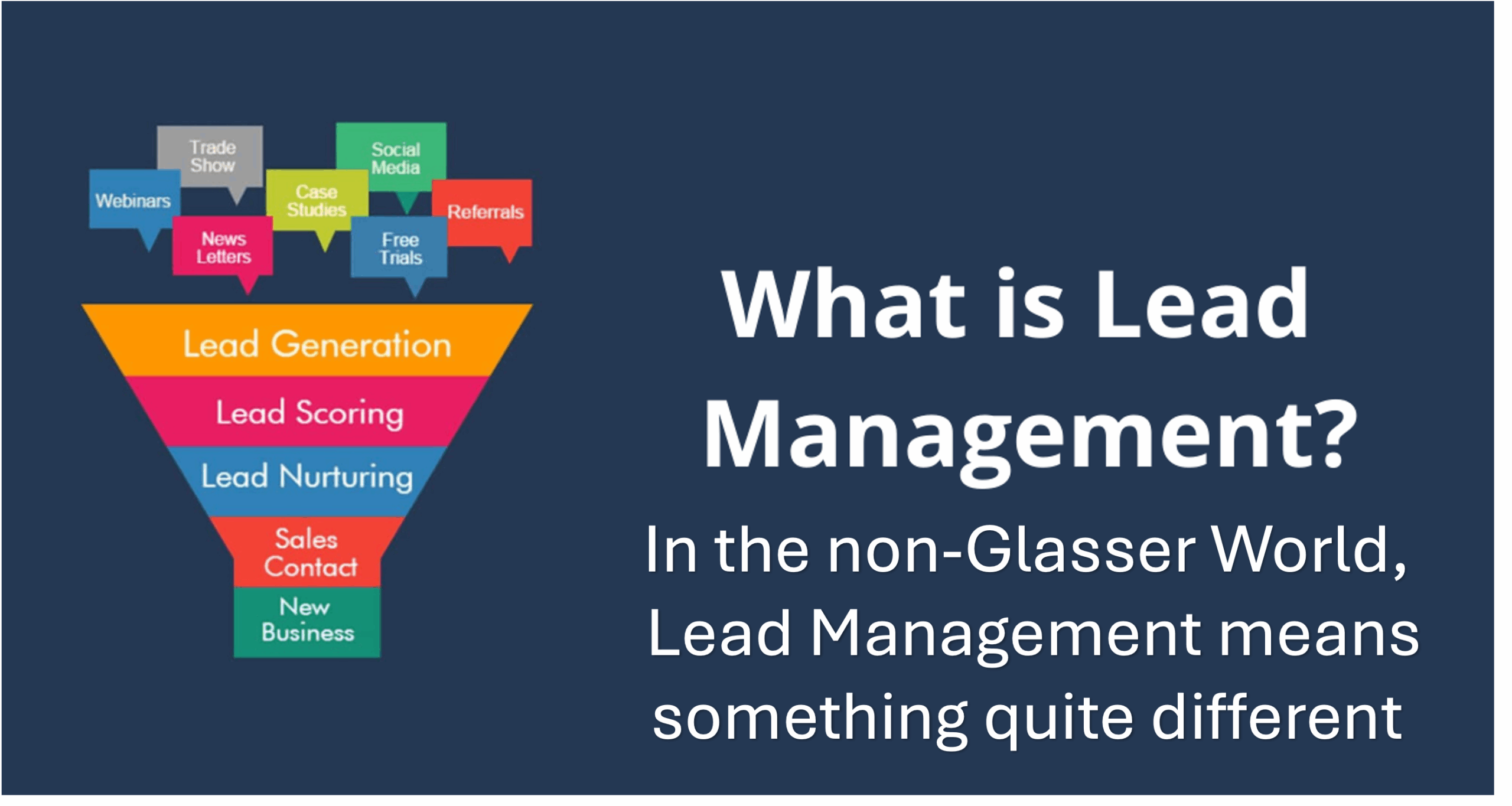
Lead Management is a term that Dr Glasser invented to contrast with a management style he called bossing. He wanted to emphasise that he was proposing a shift in the management paradigm. A great deal of the meaning of Lead Management came from this contrast. In a different age, a time when it is common to contrast leadership with management, tethering these two words together is confusing.
Now may be the time to abandon the term Lead Management. Identifying an approach to leadership as ‘Lead Management’ drives a wedge between those who have learned ‘choice theory speak’ and the rest of the leadership community. It is time to describe the style of leadership that Glasser was promoting in another way: a way that is more descriptive and research-based, and which uses language that is accessible. It doesn’t matter much when we are only working with those who come to training (we can teach them to speak Glasser jargon). However, for those of us who take our mission seriously and want to promote Glasser’s ideas to the leadership world, the language we use matters.
In ‘The Control Theory Manager’[1], Dr. Glasser defines Lead Management as a practice built on Choice Theory and internal control psychology, focused on creating conditions where employees (or students) are internally motivated to do quality work. That is a more descriptive definition but still falls short of the need for a simple, compact term to replace ‘Lead Management’.
‘Non-Coercive Leadership’ or ‘Leadership without coercion’ does capture the approach to leadership that is congruent with Choice Theory, but it’s not good practice to define something by what it’s not.
‘Choice Theory applied to Leadership’ is a phrase I have often used, and for those who have already learned Choice Theory, it works well. However, in discourse with the huge majority who are not familiar with Choice Theory Psychology, it means nothing.
If we reflect on the rationale for the practices that are defined by ‘leadership with Choice Theory’, the knowledge we draw on is our awareness of the importance of need satisfaction in work motivation. Richard Ryan and Edward L Deci[2], whose work is more focused on motivation in the workplace than Glasser’s was, offers us evidence that the need for autonomy is the one that is most relevant in that context. Deci’s research helps us understand the importance of the human will in liberating our enthusiasm and creativity at work. ‘What we do willingly, we do well’ captures the sense of this truth.
When we work autonomously, we also satisfy our need for competence (power); thus an approach to leadership that affords individuals the freedom to bring what they do best to their role satisfies two needs (and probably three because the kind of collaborative relationship that this style leads to is satisfying as well).
So, what can we call the Leadership Style that we want to promote? It seems from the current research in this area that autonomy (or personal freedom) is the key.
- This style of Leadership is productive. A sweeping meta-analysis of more than 70 studies[3] found that when leaders support autonomy by offering choice, acknowledging perspectives, and encouraging initiative, performance goes up. So does creativity. So does engagement. So does well-being.
- This approach to leadership is best for leaders. Leaders who adopt a controlling style burn out faster. The more leaders try to manage every detail, the more exhausted they become. Controlling leadership multiplies the workload. Autonomy-supportive leadership distributes it.
- Autonomy-supportive leadership is best for people in the workplace. People aren’t motivated by control. They’re motivated by meaningful and satisfying activity. They become more engaged when they can make their own choices about how to be effective. And when leaders support autonomy, the growth of capability, and relatedness, people don’t just comply – they commit.
I have tried ‘Need-Satisfying Leadership’, but taking seriously the research findings mentioned briefly above, it seems that the key need is autonomy.
The term that I am increasingly using is ‘Liberating Leadership’. It is aligned with Choice Theory and seems to make sense to those in the leadership community who have never heard of Dr Glasser. Most of the people I have tried it out on don’t ask me ‘what does it mean’ but ‘how do you do that?’ They fear that without control, they will encourage anarchy, but they understand the personal cost that controlling or transactional leadership brings. They are usually keen to explore the idea of encouraging responsible autonomy (autonomy with boundaries).
Liberating Leadership seems to me to sit well with the ‘Psychology of Personal Freedom’[4], but I am open to the ideas of my colleagues.
Let me know what you think.
[1] Dr Wm Glasser: ‘The Control Theory Manager’ (1994), later revised as ‘The Choice Theory Manager’ (1998):
[2] Richard Ryan and E.L.Deci: ‘Intrinsic and extrinsic motivation from a self-determination theory perspective: Definitions, theory, practices, and future directions’ 2000
[3] Slemp, Kern, Patrick and Ryan: Autonly Support in the Workplace: A meta-analytic Review. SpringerLink Vol 42, May 2018
[4] Dr. Wm Glasser: ‘Choice Theory. A new Psychology of Personal Freedom’

